The ‘Rescher’ plateau
A golden spot
At the beginning of the 19th century, three natural lakes stretched across a wide area in the Vinschgau Oberland: the ‘Reschensee’, the ‘Mitter-’ or ‘Graunersee’ and the ‘Haidersee’. Surrounding these lakes, in addition to pastures and meadows, were large fields on which cereals were mainly grown on the sunny side. The largely farming society in the valley was often envious of the flat to slightly steep fields and meadows, although the field work was hard there too, it could hardly be compared to the steep slopes in the side valleys or the Malser Haide.
Thanks to the bountiful harvests in the fields and the livestock farming in the meadows and pastures, the population lived relatively well, which meant that pub visits were a regular occurrence and the community was very much cultivated. Making music and dancing together as well as playing cards were a welcome pastime, especially during the strenuous winter months.
The villages of Graun and Reschen grew on the Rescher Plateau and the Alpine pass connection over the Reschen Pass also slowly brought tourism to the area, which resulted in the first ‘professional’ accommodation for travellers and the villages enjoyed a steadily increasing reputation.
In the middle of the 19th century, engineer Josef Duile from Graun realised his plan to drain Lake Graun and restore the outlet of the Karlinbach stream coming from the Langtaufer Valley, thereby gaining farmland. The project had to be interrupted due to a natural disaster in 1855, when the villages of Burgeis, Schleis and Laatsch, as well as the town of Glurns, were severely devastated when the sluices broke. The project was finally completed in 1858.
Half a century later, plans for a reservoir to generate electricity were already being drawn up by the Munich geologist R. von Klebelsberg, still under the Austrian monarchy. A few years later, the First World War began and significantly changed the situation throughout South Tyrol.
The lake damming
Fascist methods
At the end of the First World War and the peace treaty of St. Germain in 1919, Tyrol was divided and South Tyrol was ceded to Italy. A short time later, in 1920, the Italian government took up the existing plan to dam the lake and granted a concession to raise the water level by 5 metres. The extent of this damming would not have been a cause for concern as it would not have jeopardised the villages of Graun and Reschen.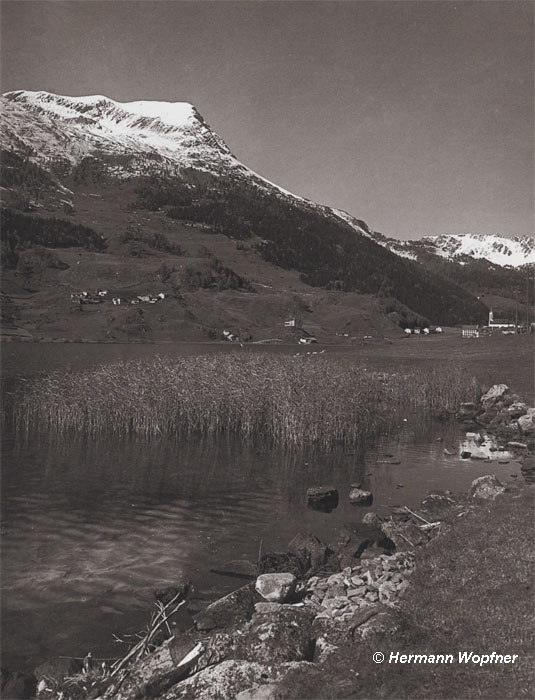
From 1922, fascism reigned in Italy and, of course, in South Tyrol. In 1939, the ‘Montecatini’ conglomerate submitted a new, far more dangerous project. Six days after the signing of the option agreement between Hitler and Mussolini, on 29 June 1939, the company presented its new implementation project. It envisaged damming the lakes from 1475 to 1497 metres, i.e. by 22 metres, which would result in the sinking of the whole of Graun and a large part of Reschen.
The population was not informed about the project and was completely ignored, as the project was only publicised by the appointed municipal secretary in Italian and for just two weeks. As a result, there were no objections from the population and even though the procedure was illegal even in fascist Italy, the ‘Montecatini’ was nevertheless authorised by the Roman ministry to carry out the construction project.
In 1940, the SEAA (Societá Elettrica Alto Adige), a special company of the ‘Montecatini’ chemical group, began construction work. However, the outbreak of the Second World War delayed the construction project considerably. In 1943, the German Wehrmacht occupied northern Italy, leading the population of the Upper Venosta Valley to believe that they were rid of this spectre for good. Nevertheless, the construction work was completely cancelled.
In spring 1947, two representatives of the Montecatini company appeared in Graun and announced that work on the realisation of the dam project would now be resumed and completed by 1949. Many attempts were now made to avert this impending disaster. The only way out would have been for the municipality to take legal action against Montecatini, as the 17 metre higher dam, which was approved in 1939 when the concession was issued, was recognised as a ‘non-substantial amendment’ to the original plan and the original concession. The chances of success for such a lawsuit were also described as very high by Montecatini's lawyers, so the company invented a new strategy and promised the population that no family would have to leave their home.
However, as the municipality of Graun let the opportunity to take legal action pass, there were probably also people among the German negotiators who considered the dam project to be necessary for the state and were also in favour of it.
The Swiss millions against Swiss morals
The pressure that the Montecatini Group exerted on the population and the municipality of Graun shortly after the Second World War had a particular reason, the trail of which leads to neighbouring Switzerland.
Spared from the Second World War, there were plans for a large power plant in the Swiss Rheinwald, which would have flooded the village of Splügen and part of Mendels. However, the local population fiercely resisted, so the Federal Council did not grant permission. The company in charge of the project, ‘Elektro-Watt’, abandoned the construction project and turned to the Montecatini Group for a stake in the Reschen dam. On 30 August 1947, a contract was concluded in which the ‘Elektro-Watt’ company offered Montecatini 30 million Swiss francs as a loan; Montecatini, for its part, undertook to supply 120 million kilowatt hours of winter energy to Switzerland for ten years.
The Swiss Heritage Protection Association uncovered the scandal in 1949 and reported on it in its association magazine: ‘The good name of our country is at stake with Swiss money. What is happening in Reschen is in such stark contrast to the principles that have developed over the years in Swiss power construction.’. However, the outcry of the Swiss people was too late and the course of events could no longer be halted.
To the Pope and in court
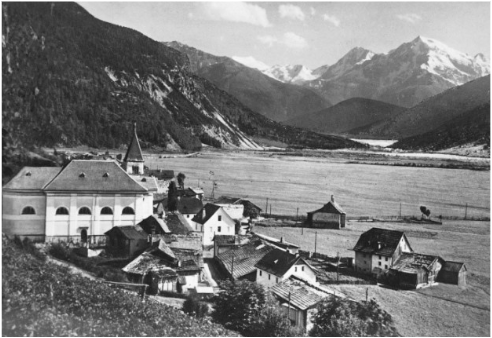 As the project could no longer be stopped, the Graun delegation was formed, consisting of Prince-Bishop Johannes Geißler and Pastor Rieper, who together asked the Pope in Rome to intervene with the Italian government to at least pay just compensation for the expropriated land. The Swiss Heimatschutz newspaper was particularly indignant about the treatment of the expellees, who were not given a suitable plot of land, but merely handed some money.
The municipality also began to take legal action against Montecatini's illegitimate behaviour. However, it is unclear what ultimately prompted the Montecatini company to be more accommodating.
For the time being, however, Montecatini stubbornly held on to the opinion that the upper Vinschgau Valley was a low-yield and barren region that was not worth living in.
It was thanks to the South Tyrolean parliamentarian Friedl Vollger, elected in 1948, that the then Minister of Agriculture and later President of the Republic, Antonio Segni, came to Graun and had an experience in the ‘Mösern’, which Volgger reported on in his book ‘Mit Südtirol am Scheideweg’: ‘There Segni was presented with a picture that he later spoke of again and again. The entire plateau, which had been flooded, was teeming with cattle, cows, young cattle and horses. Literally nothing but cattle, cattle and more cattle as far as the eye could see. With tears in his eyes, Segni admitted that he could not prevent this development, but he would make sure that the farmers were at least adequately compensated.’
Segni summoned the gentlemen of Montecatini to the ministry, where he gave them a proper ‘professional briefing’. This led to an agreement between Montecatini and the representatives of the people, according to which a joint commission had to re-evaluate the old properties and the decision on the final settlement was to be made in April 1949. The decision was delayed again and was not made until October 1949.
The farmers' protest and the downfall of Alt-Graun
On 1 August 1949, the sluices at the dam were closed for the first time on a trial basis, causing the rising water to begin flooding the fields that had not yet been harvested. The population was neither informed nor warned. The citizens of Graun rang the bell and armed themselves with sticks to march in anger with the male village population to Reschen a few days later. There they wanted to bring the Montecatini lords, who had their office in Reschen, to justice.
However, they had obviously been informed of the imminent danger beforehand, as they wanted to steal away in the car. The angry crowd, led by the priest Alfred Rieper, stopped those responsible and forced them to return to Reschen. There they had to listen to the protests of the people of Graun until the police, who had been called, intervened and took the alleged ringleaders of the riot, Pastor Rieper, Alois Theiner and Pietro Giacomelli, to Malles/Mals, where they were interrogated. During the interrogation, Pastor Rieper was physically assaulted as well as verbally abused.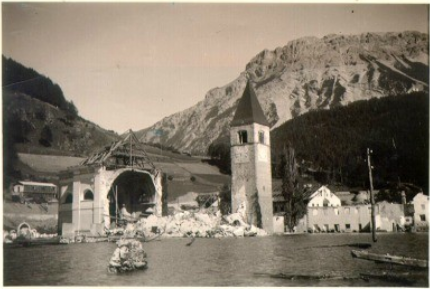
In the winter of 1949/1950, the people of Graun were still ‘allowed’ to stay in their old village, but by autumn 1949 they were all forced to make a decision: to emigrate abroad or to resettle on the slopes of St. Anna above Graun.
The new settlement plan by architect Erich Pattis was able to create a building opportunity for a quarter of the families living in Graun, while the others had to emigrate. There was no room for many of them in either Graun or Reschen, forcing them to leave the land of their fathers. A short time later, explosives began to be detonated in Graun and Reschen to destroy houses, parish churches and old cultural artefacts.
Im Laufe der zweiten Jahreshälfte 1950 stieg der Wasserspiegel zusehends an und die Stauung war endgültig.
The reservoir
Facts and figures
Size
Shoreline
Capacity
Power generation
Dam wall
6,8 km²
15,5 km, 6 km long, 1 km wide
116 Millions of cubic metres of water
250 Millions kWh
470 m long, 30 m high 200m wide Basis, 7m at the top
The destruction
677 hectares of land, of which 523 were usable agricultural land, and 163 houses were flooded (107 buildings in Graun, 47 in Reschen and 9 in St. Valentin in the Stockerhöfe area)
Around 1000 people were affected, around 150 farms lost their livelihoods and half of them had to emigrate.
1951: a bus carrying 23 passengers plunged into the lake - only one person survived
1976: first reparations - bank restoration and backfilling - since the mid-seventies, a total of approx. 35 hectares of cultivated land have been backfilled.